The best-known staffing franchise may not be the best deal for an experienced recruiter. Before buying a proven name, compare what you gain against the control and margin you surrender.
Compare your ownership options with USA Staffing Services
The best staffing franchises give owners an established brand, training, operating systems, and ongoing support, but those benefits often come with fees, restrictions, and reduced control. Express Employment Professionals, for example, says it has ranked first in its category for 15 straight years and offers more than 40 years of industry experience. A back-office partnership takes a different route because you retain full ownership while a partner handles payroll, HR compliance, insurance, and other complex operations. That approach gives experienced recruiters enterprise-level infrastructure without forcing them into a franchisor’s brand, territory, or operating playbook. Compare each option by total cost, control, support, funding, technology, contract terms, and the freedom to grow on your own terms.
Choosing between them starts with one practical question: what kind of support does your business actually need? Do you need a franchisor’s full system, or a partner that supports the company you already know how to build? Best staffing franchises versus partnership models lays out those tradeoffs side by side; here’s how.
Best staffing franchises versus partnership models
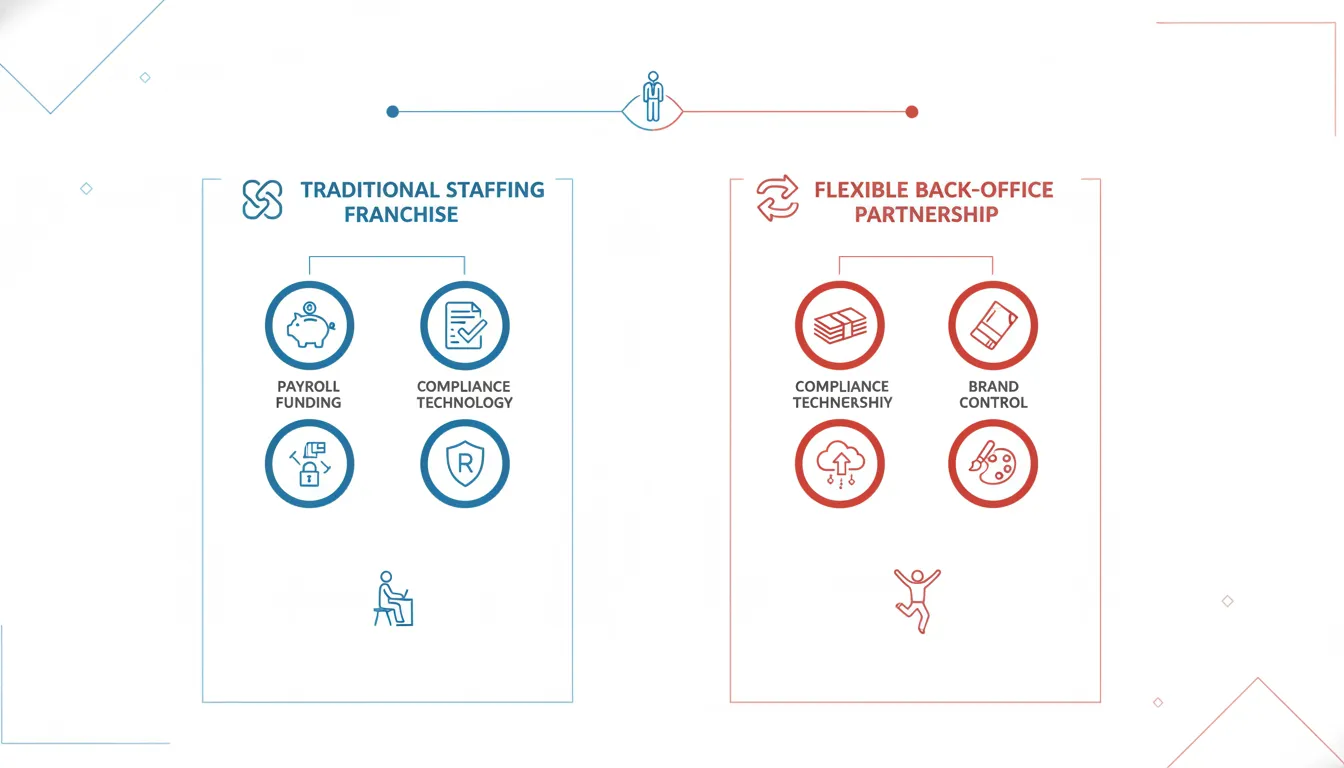
The best staffing franchises and broker-based partnerships offer two different paths into staffing business ownership. A franchise lets an owner operate under an established brand with a set business system. A partnership lets an independent owner keep their brand while a back-office partner handles key operating tasks.
Experienced recruiters often know how to win clients and fill orders, so they may not need a full franchise playbook. The central tradeoff is structure versus control. Your choice affects how much you pay, which markets you can serve, and how freely you can run the firm.
How the ownership models differ
A staffing franchise gives the owner access to a known name, processes, technology, training, and support. In return, the owner follows the franchisor’s rules and may pay upfront and ongoing fees. This setup can suit recruiters who value a defined system more than full control.
A broker-based partnership keeps the staffing company independent while shifting selected back-office work to a specialist. Some staffing back-office services cover payroll, funding, insurance, collections, human resources, and compliance support. Their pricing can be tied to business activity instead of a fixed franchise fee.
| Decision factor | Staffing franchise | Broker-based partnership |
|---|---|---|
| Upfront cost | Often includes an initial franchise fee | May have no upfront fee |
| Ongoing fees | May include royalties and other required fees | Can use performance-based pricing |
| Territory restrictions | May limit where the owner sells | Can allow broader market choice |
| Brand control | Uses the franchisor’s name and standards | Owner keeps an independent brand |
| Technology | Franchisor selects the required systems | Partner may provide tools while the owner stays independent |
| Payroll funding | Terms depend on the franchise system | Often included in back-office support |
| Compliance | Guidance follows the franchise system | Partner can serve as employer of record |
| Support | Broad operating playbook and training | Focused back-office and growth support |
Payroll and compliance responsibilities
Payroll funding and compliance deserve close review because staffing firms manage work relationships beyond sales and recruiting. The Bureau of Labor Statistics explains that temporary workers have a contractual employment relationship with their temporary help services firm. That duty makes clear ownership of payroll, insurance, onboarding, and compliance work essential.
In a franchise, the operating system sets many of these processes and may define the tools an owner must use. In a partnership, the owner can keep control of client and recruiting work while the partner manages agreed back-office duties. Experienced recruiters should confirm which party handles each risk before signing.
The right tradeoff for an experienced recruiter
Compare the full operating model, not just the entry price. Fees that seem manageable can reduce margins over time, while weak support can leave an owner handling work they planned to outsource. Contract terms should state who controls the brand, accounts, data, territory, and client relationships.
A franchise may fit a recruiter who wants a known system and accepts its limits. A partnership may fit someone who already has market skill and wants to build an independent asset. The better model is the one that protects control while covering the operational gaps that could slow growth.
What does a staffing franchise really cost?
Choosing among the best staffing franchises requires more than comparing the stated franchise fees. The real entry cost includes every dollar needed to open, win clients, place workers, and keep operating until invoices are paid. A lower fee may still lead to a higher total investment.
Build a full startup budget before judging any offer. Include the franchise fee, office setup, software, insurance, licenses, professional advice, launch marketing, and cash reserves. Also note which items are included in the franchise package and which require separate vendors.
Initial investment and working capital
Working capital deserves close review because a staffing firm must meet its obligations while waiting for client payments. The U.S. Bureau of Labor Statistics explains that temporary workers have a contractual employment relationship with the employment services firm, not the client firm. That structure makes payroll planning a core part of the cost review.
- Franchise fee and required training
- Office, equipment, and software setup
- Insurance, licenses, legal work, and accounting
- Local sales and launch marketing
- Payroll funding and an operating cash reserve
Ask the franchisor to define every required expense and the assumptions behind its estimate. Check whether payroll funding is part of the offer, arranged through another provider, or left to the owner. The answer can change both cash needs and risk.
Ongoing fees and limits
Next, map every recurring charge. Review royalties, brand marketing fees, software costs, training charges, renewal fees, and any required purchases. Learn whether each fee is fixed, tied to sales, or based on another measure.
Contract terms can also carry an economic cost. Territory limits, approved vendor rules, service restrictions, and renewal terms may affect how the firm grows. Compare those limits with payroll and compliance support, which can support an independent agency without franchise ownership.
A practical total-cost comparison
Create the same cost model for every option. Add startup spending, expected recurring fees, payroll funding costs, and a reasonable cash reserve. Then test the model under slower sales and slower client payments, rather than relying only on the strongest forecast.
Review what you receive for each charge, including systems, compliance help, training, sales support, and brand reach. Owners who plan to start a staffing agency should also price an independent path. This comparison shows whether the franchise premium fits the support and control offered.
Territory and brand control shape your growth ceiling
The best staffing franchises are not defined by brand recognition alone. Their operating rules also set the limits on where and how an owner can grow. Before comparing projected returns, review the territory, brand, and client-control terms that remain in force after opening.
Territory rights and expansion paths
An exclusive territory can reduce conflict with nearby owners, but it can also become a hard border. Ask whether exclusivity covers client offices, worker locations, or both. National accounts and remote placements may follow different rules, so the contract language matters more than a sales summary.
Growth plans should account for the cost and process of adding territory. Check whether the franchisor may serve accounts inside your market or reserve certain clients. A model without fixed territories may offer more reach, but owners must still build a clear local position and sales plan.
Brand standards versus local positioning
Shared branding can help a new firm look established. In return, the owner may give up control over the website, service mix, ad claims, pricing, or local campaigns. Those limits can protect brand consistency while making it harder to serve a distinct niche.
Review who approves local marketing and who owns the leads it creates. Also ask whether you can build a personal reputation under the main brand. Owners who want more choice can compare franchises with operational support for staffing agencies, which separate operating support from brand ownership.
Client ownership and long-term value
Client control affects both daily operations and the value of the firm at exit. The U.S. Bureau of Labor Statistics explains that temporary workers have an employment relationship with the employment services firm. They do not have one with the requesting client. That makes the structure behind contracts, payroll, and worker records a key review point.
Ask who owns client agreements, candidate records, local phone numbers, and digital accounts. Then review what happens after termination, sale, or a move outside the system. Limits on transfer rights, client contact, or data access can narrow the pool of buyers and reduce enterprise value.
Control is not always better than support. The right balance depends on whether your goal is one protected local office or a firm that can cross markets. Evaluate each rule against the business you want to own later, not only the help you need at launch.
See whether a flexible back-office partnership fits your growth plan
Which model handles payroll funding and compliance better?
The best staffing franchises and independent partnership models can both provide a working back office. The better choice depends on who funds payroll, carries employer duties, and handles daily issues. Compare the full operating system, not just the software list or brand name.
Payroll funding and technology
Payroll funding matters because clients may pay invoices after workers expect their checks. Ask each provider who advances payroll, how collections work, and what happens when a client pays late. Also review funding limits, approval rules, fees, and any reserve requirements before signing.
Technology should connect recruiting, onboarding, time entry, payroll, billing, and reporting. A franchise may provide a required system within its standard process. USA Staffing Services gives independent firms access to Bullhorn ONE while serving as their back-office partner, not as a staffing firm.
- Confirm who owns the candidate, client, and financial data.
- Test how the system handles timecard errors, payroll changes, and invoice disputes.
- Ask whether support comes from one team or several outside vendors.
- Review what happens to data and records if the relationship ends.
Request a live test using a typical order and timecard. Follow the record from worker setup through invoice creation. This shows where staff must enter data twice and who fixes errors.
Employer-of-record support
Employer-of-record support is more than sending checks. Temporary workers usually have a contractual employment relationship with the employment services firm, according to the U.S. Bureau of Labor Statistics. That makes clear roles for onboarding, payroll taxes, insurance, and worker issues essential.
Ask who completes worker onboarding, verifies required forms, manages benefits, handles claims, and answers HR questions. Then map the handoff for each task. A sound model should state who responds when a worker is injured. It should also cover client workplace concerns.
Compliance ownership and day-to-day support
A franchise often sets standard procedures across its network. That structure can help an owner who wants a defined playbook. Yet owners should still confirm which compliance duties remain with their local business and which services require extra fees.
An independent owner using a back-office partner keeps control of the staffing business while outsourcing key operating work. USA Staffing Services supports payroll, payroll funding, collections, temporary-worker HR, insurance, and compliance. Its role is to support the agency that recruits and places workers.
Compare providers by requesting a written responsibility chart and a sample issue workflow. The review should cover payroll errors, late client payments, claims, worker complaints, and record access. A clear view of back-office capabilities can help owners judge the support behind each offer.
How should you compare staffing business opportunities?
The best staffing franchises for one recruiter may be a poor fit for another. Start with your goals, then compare each offer on the same terms. Look past brand names and sales forecasts. Your review should show who controls the business, who carries each risk, and how each party gets paid.
Define the business you want
Decide whether you want a proven franchise system or an independent firm with outside support. A franchise may provide a set brand, process, and operating rules. An independent model can give you more control over your market, client mix, and growth plan. Review relevant back-office partnership models beside franchise offers, not as an afterthought.
- Set your goals. Write down your target clients, staffing niche, income needs, desired launch date, and long-term exit plan.
- Map every cost. Compare upfront fees, royalties, technology charges, insurance, payroll funding terms, marketing costs, and required working capital.
- Test the economics. Build conservative, expected, and strong sales cases. Show gross profit, fixed costs, owner pay, and cash needs in each case.
- Review the contract. Ask an experienced attorney to explain territory limits, quotas, renewal terms, noncompete clauses, personal guarantees, termination rights, and sale restrictions.
- Verify the support. Request a live view of training, technology, payroll, compliance, collections, and sales help. Speak with current and former owners.
- Score control and exit fit. Confirm who owns the client relationships, brand, data, and equity. Check whether the agreement supports your planned exit.
Stress-test the numbers
Do not compare opportunities using revenue alone. Compare owner earnings, cash flow timing, recurring fees, and the cost of limits on growth. Temporary staffing demand can shift before the wider job market changes, according to the U.S. Bureau of Labor Statistics. Test lower sales and slower client payments before you commit.
Ask each provider to explain every assumption behind its forecast. Then confirm those assumptions with owners who operate in markets like yours. A strong offer should still work without perfect sales, instant collections, or constant owner overtime.
Check control, support, and exit terms
Operational support has value only when it removes work or lowers risk. Ask who handles worker onboarding, payroll, tax filings, insurance, claims, compliance, and collections. Define response times and escalation paths. Also confirm which services cost extra and which remain available during a dispute.
Your exit plan can expose major differences between offers. Check whether you can sell the firm, transfer client accounts, change providers, or keep your brand. Price matters, but ownership rights and contract limits may shape the value you can build.
Who is a back-office partnership best for?
A back-office partnership is best for an experienced recruiter who can win clients and fill orders but does not want to build payroll funding, insurance, HR, and compliance operations alone. USA Staffing Services' Staffing Agent Program offers this exact model — you keep your own staffing brand while getting EOR support, payroll funding, and back-office infrastructure without franchise fees. It preserves independent ownership while placing essential administrative work with a specialized staffing-industry partner.
Experienced recruiters who want ownership
A back-office partnership often fits recruiters who already know how to win clients, fill roles, and manage relationships. They do not need a preset sales script or a familiar name to open doors. Instead, they want to own their agency, choose their market, and shape their service around client needs.
This option can suit a proven recruiter who is ready to trade brand recognition for more control. The owner stays responsible for sales, recruiting, pricing, and growth choices. A partner handles selected operating work behind the scenes, without directing the agency’s market strategy.
Owners who want to focus on the front office
Strong recruiters do not always want to build payroll, HR, insurance, and compliance systems from scratch. A partnership lets them spend more time winning orders and placing talent. It also gives them a clear way to learn about back-office partnership models before choosing which tasks to keep.
The split matters because temporary workers have a contractual employment relationship with the staffing firm, not the client. The U.S. Bureau of Labor Statistics explains this employment structure in its review of temporary help services. Owners should know who carries each duty before signing an agreement.
A good fit usually has these traits:
- A track record of finding clients and placing candidates
- A clear niche, local market, or existing book of business
- Comfort making independent sales and hiring choices
- A desire to outsource payroll and other back-office work
- Enough discipline to run the front office without a franchise playbook
When a franchise may fit better
A franchise may make more sense for a first-time owner who wants a known brand and a set operating system. It can also help someone who values detailed guidance more than freedom over the business model. The best staffing franchises should be judged by how well that structure matches the owner’s skills and goals.
By contrast, a back-office partnership may fit an owner who can create demand but needs help supporting placed workers. This owner wants to keep control of the brand, client terms, and growth plan. Recruiters weighing that path can review how to start a staffing agency while outsourcing key operating tasks.
Before choosing, assess what you can already do well and where mistakes would carry the most risk. A skilled recruiter may need operational support, not a full business identity. An early-stage owner may prefer the guardrails and recognizable name that a franchise can provide.
Questions to ask before you sign
The best staffing franchises on paper may not offer the best deal for your goals. Before signing, ask for the full agreement, disclosure documents, and fee schedule. Have a franchise attorney and accountant review them. Their job is to find costs, limits, and risks that a sales call may not reveal.
Fees, funding, and financial control
Ask for every required payment, not just the initial fee. Review royalties, marketing charges, software costs, renewal fees, transfer fees, and any required purchases. Then ask whether each charge is fixed, tied to revenue, or due even during a slow month.
Payroll funding deserves its own review. Ask who supplies the funds, when your agency must repay them, and what happens when a client pays late. Compare those terms with back-office partnership models, which may price support in a different way.
- Is funding capped, and can that cap change without your approval?
- Who handles collections, bad debt, and client credit checks?
- Can you choose your bank, insurer, software, and other vendors?
Territory, clients, and operating limits
Ask who owns each client relationship and the related data. Confirm whether you can serve clients outside your territory, recruit across state lines, or sell into new industries. Also check any limits on national accounts, remote work, pricing, and services you may offer.
Clarify what happens to your clients if the agreement ends. Can you keep serving them, or does the brand retain the accounts? Review noncompete, nonsolicitation, and confidentiality terms with counsel. Ask whether those rules also apply to your staff and for how long.
Compliance, service levels, and exit terms
The U.S. Bureau of Labor Statistics says temporary workers have a contractual employment relationship with the employment services firm. They do not have one with the requesting client firm. That makes the contract’s split of employer duties a key issue. Ask who handles onboarding, payroll tax, workers’ compensation, claims, wage rules, and required notices.
Put service promises in writing. Ask for response times, payroll cutoffs, error correction steps, escalation contacts, system uptime terms, and remedies when service falls short. Confirm which support is included and which help carries an added fee.
Finally, study the exit before you study the launch. Ask about the agreement term, renewal process, cure periods, termination rights, and post-exit fees. Confirm how active payroll, open invoices, worker records, client data, and software access will transfer after separation.
Frequently Asked Questions
What is the most profitable staffing franchise?
No single staffing franchise is the most profitable for every owner. Results depend on local demand, client mix, operating costs, financing, and the owner’s sales ability. Rankings can help with initial research, but they do not guarantee profit. For example, Express Employment Professionals reports that it has ranked first in its Entrepreneur staffing franchise category for 15 consecutive years.
How much does it cost to start a staffing agency franchise?
The total cost varies by brand and may include the franchise fee, required working capital, office costs, technology, insurance, and ongoing royalties. Review each franchisor’s current Franchise Disclosure Document before comparing options. Also compare those expenses with an independent back-office partnership, which may replace upfront franchise fees and royalties with pricing tied to business activity.
Do I need experience to own a staffing franchise?
Requirements vary by franchisor, but staffing, recruiting, sales, or leadership experience can make ownership easier. A new owner must still understand client development, candidate sourcing, cash flow, and employment responsibilities. Some franchises provide training for owners from other industries. An experienced recruiter may prefer an independent partnership that supplies back-office infrastructure while preserving control of the business.
What is the difference between a new staffing franchise and a resale?
A new staffing franchise starts without an existing client base, team, or local operating history. A resale is an established franchise purchased from its current owner and may include active accounts, employees, and revenue. Buyers should review contracts, financial statements, client concentration, and transfer rules. A resale can shorten the launch period, but inherited costs or weak accounts can reduce its value.
Is buying a staffing franchise profitable?
A staffing franchise can be profitable, but the brand name alone does not determine the outcome. Profit depends on gross margin, payroll funding needs, royalties, local competition, and the owner’s ability to win and retain clients. Compare the franchisor’s disclosure documents and speak with current owners. Then model the same sales assumptions under a back-office partnership to see which structure leaves more operating income.
Ready to Choose a More Flexible Staffing Model?
Waiting to choose an operating model can delay sales activity and leave key ownership, cost, and support questions unresolved. Starting your review now gives you time to compare commitments, test your assumptions, and build a practical launch plan before administrative demands compete for attention. A clear decision can also protect your time and keep the firm focused on clients, candidates, and growth from the start.
Ready to compare your options with a team that supports independent staffing entrepreneurs? Bring your priorities, operating questions, preferred timeline, and concerns about control to a direct conversation. You can discuss how the partnership would fit your goals without committing to a franchise structure. Schedule a conversation with USA Staffing Services to talk about a back-office partnership and identify the support your plan requires.

Written By
David Ellison
Staffing Operations & Risk Management Specialist
David Ellison is a detail-oriented Staffing Professional specializing in risk management, operations, and back-office support. At USA Staffing Services, he empowers staffing firms by managing payroll, workers' compensation, and HR compliance, enabling them to focus on talent acquisition and business growth.